This guide is for anyone planning a visit, researching local history, or just curious about one of Belfast’s best-known landmarks. It walks through the full Belfast Castle history, from a medieval Norman fort beside the River Lagan to the Victorian mansion that still stands on Cave Hill today.
Expect short, scannable sections covering each major chapter: the original castle in the city centre, the Plantation rebuild under Sir Arthur Chichester, the Donegall family’s move north, and the gift to the city in 1934.
Overview of Belfast Castle
Belfast Castle sits 400 feet up on the eastern slopes of Cave Hill, looking down over the city, the Lough, and the wider Belfast Hills. It is one of the most photographed buildings in Northern Ireland, and the surrounding castle grounds form part of Cave Hill Country Park.
The current Belfast Castle is the third building to carry the name. There was a medieval Belfast Castle near where Castle Place now runs, a Plantation-era replacement built by the Chichester family in 1611, and the Victorian castle on Cave Hill, which was completed in 1870.
Each phase ties directly into the wider history of Belfast. Trace the castle and you trace the city, from a small Norman crossing point on the Lagan to a Victorian industrial powerhouse and the modern visitor destination it is today.
Location: Cave Hill Country Park and the Belfast Hills
Cave Hill is the basalt outcrop that dominates the skyline above north Belfast. Belfast Castle is located on its eastern flank, tucked into woodland just below the cliffs and the prominent profile known locally as Napoleon’s Nose.
From the terrace, the views are hard to beat. On a clear day you can see straight down to Belfast city centre, across the lough to County Down, and out towards the Mourne Mountains. The visitor centre on Cave Hill itself explains the geology, wildlife, and history of the area.
The castle grounds form one corner of Cave Hill Country Park, a 750-acre site of grassland, woodland, and waymarked walking trails. The park links directly to the rest of the Belfast Hills, so the castle is a natural starting point for a longer walk.
The First Belfast Castle (medieval to early modern)
First Belfast Castle: origins and function
The original castle is thought to have been founded by Norman invaders in the late 1100s or early 1200s, possibly under John de Courcy. It was a basic defensive structure rather than a princely mansion. Its job was to control the ford across the River Lagan and the small settlement growing on the banks.
This medieval Belfast Castle stood near what is now Castle Place, in the heart of Belfast city centre. The streets around Castle Lane and Donegall Place still mark roughly where it once sat. So when people ask about the history of Castle Place Belfast, they are really asking about the footprint of the first Belfast Castle.
Early references describe it as a tower house with stone walls. Nothing of that original castle is visible above ground today.
Medieval occupants and conflicts
For three centuries the castle changed hands repeatedly. The O’Neill dynasty, the most powerful Gaelic Irish family in Ulster, held it for long stretches in the 1400s. English armies took it back, sometimes by siege, sometimes by treaty. Sir Brian O’Neill is one of the named occupants from this period.
It was burned, rebuilt, and damaged several times through the 1500s, particularly during the long-running clashes between the Crown and the Ulster lords. By the time of Tyrone’s Rebellion (the Nine Years’ War, 1594 to 1603), the medieval castle was already in poor condition. Even so, it was still treated as a useful defensive post.
Foundations and finds from this era almost certainly still survive beneath the modern shops and pavements of central Belfast, which is why archaeologists continue to watch the city centre carefully whenever building work begins.
Plantation Era and Donegall Developments
Chichester and the Plantation castle
In 1611, Sir Arthur Chichester, Lord Deputy of Ireland and one of the chief architects of the Plantation of Ulster, built a new castle on the same site. He had been granted the Castle of Belfast and a large surrounding estate by James I a few years earlier.
Chichester’s rebuilt castle was a different kind of building. Part fortified house, part comfortable residence, it was made of stone, timber, and brick. Around it, Chichester laid out a small planned town that would grow into Georgian and Victorian Belfast. Many of the famous Belfast street names, including Chichester Street and Donegall Square, trace back to this period.
The Plantation castle stood for almost a century. In 1708 a fire broke out and the castle burned to the ground. Three of the family’s daughters died in the blaze. The Chichester family never rebuilt on the same site.family well into the late 1800s.
Donegall House and the Donegall period
The Chichesters held the Earldom and later the Marquessate of Donegall. After the fire, they moved out of central Belfast for decades. The 2nd Marquess of Donegall returned around 1802 and settled in Donegall House, a town residence only a few hundred yards from the original medieval castle site.
He also kept a country home, Ormeau Cottage, which he expanded into Ormeau House. By the 1820s he had sold Donegall House and made Ormeau his main base. The grounds of Ormeau House are now Ormeau Park, the oldest municipal park in Belfast.
When the 2nd Marquess of Donegall died in 1844, his son inherited heavy debts. The 3rd Marquess sold off most of the family’s Belfast estates and street holdings. The names stuck though, which is why the Donegall and Chichester family still echo through the city’s geography.
The Victorian Belfast Castle on Cave Hill
Building the new Belfast Castle estate
The 3rd Marquess of Donegall kept one slice of land for himself: a strip of high ground on the lower slopes of Cave Hill. Between 1867 and 1870, the new Belfast Castle was built there.
This is the building visitors see today. Construction was largely funded by the Marquess’s son in law, Lord Ashley, who later became the 8th Earl of Shaftesbury. Ashley was married to Donegall’s only surviving child, Lady Harriet Chichester. The young Lord Belfast, Donegall’s son, had died years before, which is why the inheritance ran sideways through the female line.
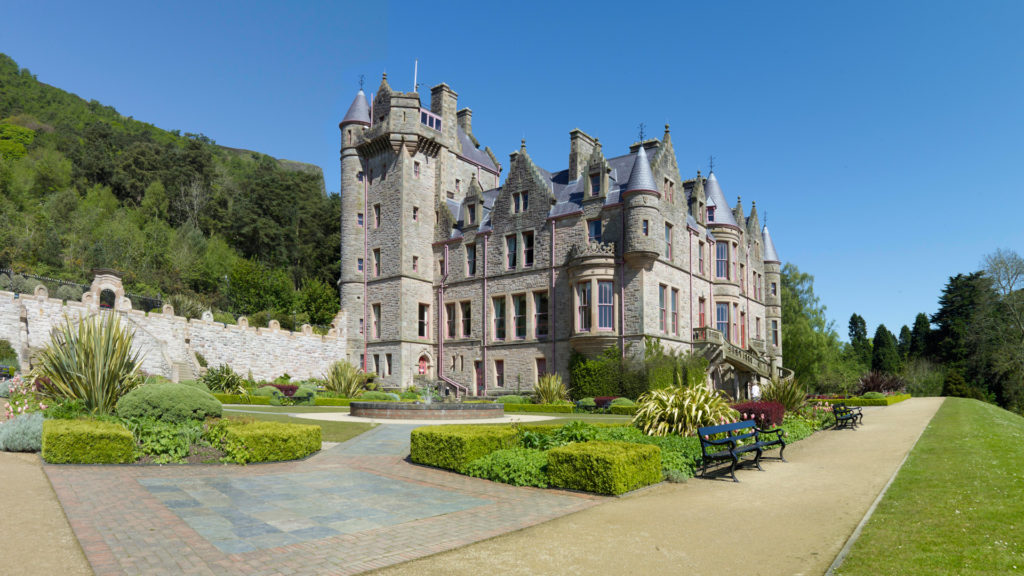
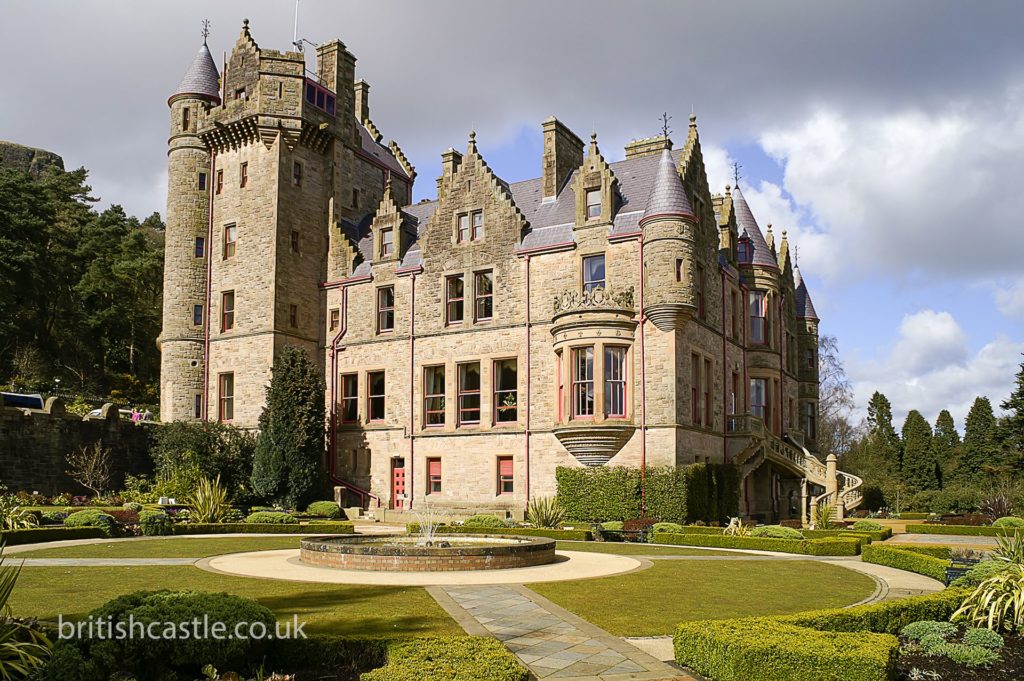
The castle was built from local pink sandstone, with finer detail in cut ashlar. Its hillside setting was chosen for the view, and the construction dates put the current Belfast Castle at over 150 years old.
Belfast Castle estate: layout and features
The estate was laid out as a Victorian gentleman’s seat. The land had originally formed part of a deer park, and several of those parkland features survive. The lawns roll down towards the city, and the woodland behind blends straight into the wider Cave Hill paths.
The most photographed feature is the outdoor stone staircase, a winding stone staircase that curves down from the terrace into the garden. It was added during a later refurbishment and is now a popular spot for wedding receptions.
The main gate lodge sits at the foot of the drive, built from the same sandstone as the castle. It originally housed the gatekeeper, who controlled access to the private estate before the gift to the city.
Architecture and the Gate Lodge
The castle is one of the best examples of the popular Scottish Baronial style in Northern Ireland. That look borrows from medieval Scottish tower houses, with crow-stepped gables, conical turrets, and heavy stonework. It was designed by Sir Charles Lanyon, his son John Lanyon, and W. H. Lynn, working as the prominent Belfast firm Lanyon, Lynn and Lanyon.
Inside, look for the carved Shaftesbury crest above the main fireplace, the timber-lined former chapel that now serves as a function room, and the heavy stone doorways that anchor each public room. These are the kind of features heritage copy tends to highlight, because they tell the family history without needing labels.
The gate lodge is worth a closer look in its own right. It mirrors the main castle in miniature, with the same Scots Baronial style detail, and works well as an interpretive asset for visitors approaching on foot.
Shaftesbury, Gift to the City, and Modern History
When the 3rd Marquess of Donegall died in 1883, the castle passed to Lord Ashley, by then the 8th Earl of Shaftesbury. He died only three years later in 1886, leaving the estate to his teenage son, Anthony Ashley Cooper, the 9th Earl of Shaftesbury.
The 9th Earl, often known simply as Lord Shaftesbury, held the castle longer than any other private owner. He served as Lord Mayor of Belfast in 1907 and as Chancellor of Queen’s University. He was active in city life, in philanthropy, and in the Shaftesbury family’s wider charitable work.
After the First World War, the cost of running a Victorian estate had become impossible. In 1934, Lord Shaftesbury gave Belfast Castle and most of its surrounding grounds to the City of Belfast. The Shaftesbury family no longer owned Belfast Castle, but the gift gave the building a long second life.
Through the mid-20th century, the city used the castle for receptions, dances, and afternoon teas. Day-trippers picnicked in the grounds. After the Second World War, parts of the wider estate, including land near Antrim Road and Downview Park West, were taken in for housing.
Between 1978 and 1988, the castle was given a major £2 million refurbishment by the architects Hewitt and Haslam. That ten-year project added the famous outdoor stone staircase, modernised the interior, and made the building practical for public use. Further repair work followed in 2003, and conservation has continued in stages ever since.
Belfast Castle Estate Today: Use and Management
The castle is managed by Belfast City Council and is free to visit. The Cellar Restaurant and the Castle Tavern coffee shop serve food and drink throughout the day, and afternoon teas are a popular booking. There is an antique shop, a small visitor centre, and an adventure playground in the grounds.
Several rooms inside the castle can be hired out. They are used for business meetings, conferences, and private events, with options that scale from boardroom-sized rooms to the larger reception spaces.
The estate hosts a busy annual calendar. Wedding receptions are the headline use, but the castle also runs heritage open days, seasonal markets, family activities, and outdoor concerts in the castle grounds.
Visiting: Practical Information from the City Centre
The main entrance to Belfast Castle sits just off Antrim Road in north Belfast, about three miles from the city centre. By car, it is a short drive up through the suburbs, with free parking on site.
Public transport is straightforward. Several Metro bus routes run from Belfast city centre up Antrim Road and stop close to the gate lodge. From there, it is a steep but pleasant ten-minute walk up the drive.
For the best viewpoints, do not stop at the castle terrace. Keep walking. The path up to McArt’s Fort, on top of Cave Hill, gives a panoramic sweep of Belfast, the lough, and the Belfast Hills. It is one of the finest free views in Northern Ireland.
Archaeology and the History of Belfast Under the City Centre
The medieval Belfast Castle has not vanished. It lies buried under the modern shops and offices around Castle Place, Castle Lane, and Donegall Place. Whenever excavation work happens in this part of the city centre, archaeologists watch carefully for stone foundations, ditches, and finds tied to the original castle.
For deeper reading, the Ulster Journal of Archaeology and the Northern Ireland Sites and Monuments Record both publish material on Belfast’s medieval layer. Queen’s University Belfast also holds reports from city centre digs.
The links between the castle sites matter. The medieval castle, the Plantation castle, and the Victorian castle on Cave Hill are not three random buildings. They are three stages of the same long story, connected by the Chichester and Donegall families, their tenants, and the city that grew up around them.
Cultural Significance and Community Value
Belfast Castle is part of the city’s identity. It appears on postcards, tourism campaigns, and school trips. For many Belfast families it is the venue where someone got married, where a grandparent had afternoon tea, or where a school visit first sparked an interest in local history.
Community engagement works best when it draws on those personal stories. Oral history projects, family photo archives, and local school partnerships can all add depth to the standard heritage script.
For interpretive displays, three themes carry the most weight: the medieval castle hidden beneath the city centre, the Donegall and Shaftesbury family stories, and the long story of Cave Hill itself, from Iron Age fort to modern country park.
Sources and Further Research
For verifiable Belfast Castle history, start with the Belfast City Council heritage pages and the Public Record Office of Northern Ireland (PRONI), which holds Donegall and Shaftesbury family papers. The Linen Hall Library and Belfast Central Library also keep strong local history collections.
For academic work on the Belfast hills and city centre archaeology, look to Queen’s University Belfast, the Ulster Archaeological Society, and the journal Ulster Journal of Archaeology.
For visitor and access information, the Cave Hill Country Park visitor centre on site is the most reliable starting point, or their website when you’re planning your visit. Staff there can point you to current trail maps, event programmes, and ongoing conservation work at the castle.